Async AI Monitoring: Store-and-Forward Vitals Explained
Store-and-forward health monitoring decouples vital sign collection from real-time clinical oversight, enabling healthcare organizations to scale population health management through AI-powered triage. This asynchronous approach optimizes clinician time while maintaining continuous patient surveillance across diverse applications from pre-appointment screening to chronic disease management.

Remote patient monitoring is transforming healthcare delivery by enabling continuous health assessment without requiring synchronous clinical encounters. Store-and-forward health data collection, powered by AI-driven vital sign monitoring, allows healthcare organizations to scale population health management while optimizing clinician time and resources.
This approach fundamentally changes clinical workflows by decoupling data collection from real-time provider availability. In this post, we'll explore how asynchronous AI monitoring creates new possibilities for population-scale health surveillance and clinical decision support.
What Is Store-and-Forward Health Monitoring?
Store-and-forward health monitoring captures patient vital signs and health data at the point of care or patient interaction, then transmits this information to clinical systems for later review and analysis. Unlike traditional monitoring that requires real-time clinician oversight, this approach allows health data to be collected continuously and reviewed in batch.
One of the primary advantages of asynchronous vital sign monitoring is its ability to integrate seamlessly into existing patient workflows. Whether embedded in insurance check-ins, pre-appointment screenings, or occupational health assessments, contactless vital sign capture can occur without disrupting operational efficiency.
This approach also addresses a critical healthcare resource constraint: clinician time. Rather than requiring provider attention for every measurement, AI algorithms can flag anomalies and prioritize cases that need clinical review, allowing healthcare teams to focus on patients who require intervention.
Finally, store-and-forward monitoring enables population-scale health surveillance that would be impossible with traditional synchronous models. Healthcare organizations can monitor hundreds or thousands of patients continuously while maintaining clinical oversight through intelligent triage systems.
When implementing asynchronous monitoring systems, organizations should ensure compliance with relevant healthcare data standards and establish clear protocols for clinical review and follow-up.
With store-and-forward health monitoring, organizations can capture vital signs from entire populations without requiring real-time clinical resources for every measurement.
Asynchronous vs Synchronous Health Monitoring
If you're considering implementing remote patient monitoring in your healthcare system, understanding the difference between asynchronous and synchronous approaches is crucial for selecting the right solution.
Here's a breakdown of each approach.
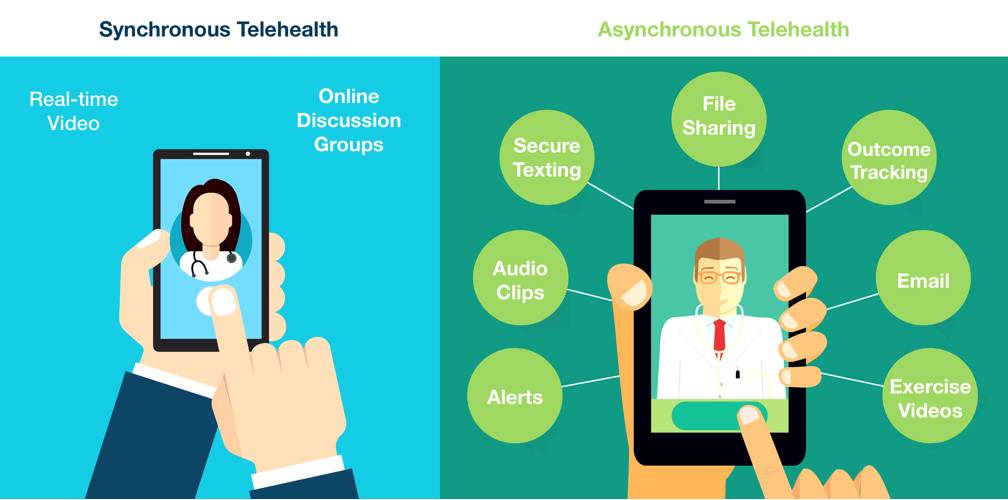
Asynchronous health monitoring captures vital signs and health data without requiring real-time clinical oversight. This approach is ideal for routine monitoring, population health surveillance, and pre-appointment triage where immediate clinical intervention isn't necessary.
Synchronous monitoring, on the other hand, involves real-time data collection with immediate clinical review. This approach is better suited for acute care situations or patients requiring continuous clinical supervision.
Synchronous monitoring provides immediate clinical feedback but requires dedicated clinician time for every measurement, limiting scalability.
The optimal monitoring approach depends on your patient population, clinical use cases, and available resources. Many healthcare organizations implement hybrid models that use asynchronous monitoring for routine surveillance and synchronous monitoring for high-risk patients.
If you're evaluating monitoring solutions, consider how each approach aligns with your clinical workflows and resource constraints.
Key Takeaway: Health monitoring can be asynchronous (store-and-forward) or synchronous (real-time). The best approach depends on clinical requirements and organizational capacity.
Challenges of Asynchronous Health Monitoring
While store-and-forward health monitoring offers significant advantages, implementing these systems presents several operational and technical challenges that healthcare organizations must address.
Here are some key challenges you may encounter when deploying asynchronous monitoring systems.
1. Data Integration Infrastructure
Implementing asynchronous monitoring requires robust data pipelines that can capture, store, and route health information to appropriate clinical systems. This can be challenging for organizations with legacy EHR systems or limited IT infrastructure.
2. Clinical Workflow Integration
Healthcare teams need training on how to review and act on asynchronously collected health data. This requires establishing new clinical protocols and ensuring staff understand how to prioritize and respond to AI-flagged anomalies.
3. Patient Engagement and Compliance
One challenge with asynchronous monitoring is ensuring consistent patient participation when clinical oversight isn't immediate. Organizations must design engagement strategies that encourage regular data collection without real-time provider interaction.
4. Clinical Validation and Standardization
Asynchronous monitoring systems require clear protocols for clinical validation of AI-generated insights and standardized approaches to follow-up care. Without proper standardization, organizations may see inconsistent clinical responses to similar health data.
5. Technology Investment and ROI
Deploying asynchronous monitoring requires investment in AI-powered health assessment tools and data infrastructure. Organizations must evaluate the cost-benefit ratio, particularly when considering population-scale implementations.
Despite these challenges, asynchronous health monitoring provides substantial value for healthcare organizations. It enables population-scale health surveillance, improves clinical efficiency, and supports proactive care management.
It can also enhance patient outcomes by enabling earlier detection of health changes and more consistent monitoring of chronic conditions.
When evaluating asynchronous monitoring solutions, healthcare organizations should assess both the implementation challenges and long-term benefits to ensure alignment with their strategic objectives.
Pro Tip: Use Upvio's Vitals AI for contactless, asynchronous vital sign monitoring. Enable population-scale health surveillance with AI-powered anomaly detection and clinical triage.
Key Takeaway: Asynchronous health monitoring enables scalable population health management but requires careful planning for data integration and clinical workflow optimization.
Asynchronous Health Monitoring Applications
Here are key applications where store-and-forward health monitoring creates significant clinical and operational value.
In pre-appointment triage, patients can complete contactless vital sign assessments before clinical encounters, allowing providers to prioritize cases and prepare for consultations more effectively.
In insurance underwriting, health plans can integrate vital sign monitoring into member onboarding processes, capturing baseline health data for risk assessment and care management.
In occupational health, employers can implement routine health surveillance for workers in high-risk environments, monitoring vital signs and stress levels without requiring on-site medical staff.
In chronic disease management, healthcare organizations can monitor patients with hypertension, diabetes, or cardiovascular conditions between appointments, flagging concerning trends for clinical review.
In clinical environments where routine monitoring is essential, store-and-forward health assessment proves highly practical. Healthcare organizations can maintain continuous oversight of patient populations while optimizing clinical resources through intelligent triage and anomaly detection.
Key Takeaway: Asynchronous health monitoring enables scalable population health management across diverse clinical applications, from pre-appointment screening to chronic disease surveillance.
Conclusion
Store-and-forward health monitoring represents the future of scalable population health management. By decoupling vital sign collection from real-time clinical oversight, healthcare organizations can monitor entire patient populations while optimizing clinician time through AI-powered triage and anomaly detection.
While implementing asynchronous monitoring systems requires careful planning and infrastructure investment, the clinical and operational benefits justify the effort.
If you're considering asynchronous health monitoring, Upvio's Vitals AI provides contactless vital sign assessment that integrates seamlessly into existing clinical workflows. Our AI-powered platform captures heart rate, blood pressure, respiratory rate, and other vital signs using only a smartphone camera, enabling population-scale monitoring without additional hardware.
Ready to see how async monitoring fits your clinical workflows? Schedule a demo today!
Keep exploring with these related resources:
Explore Vitals AI for remote, camera-based vital signs monitoring.
Explore Why Vital Signs Matter in Psychiatry.